
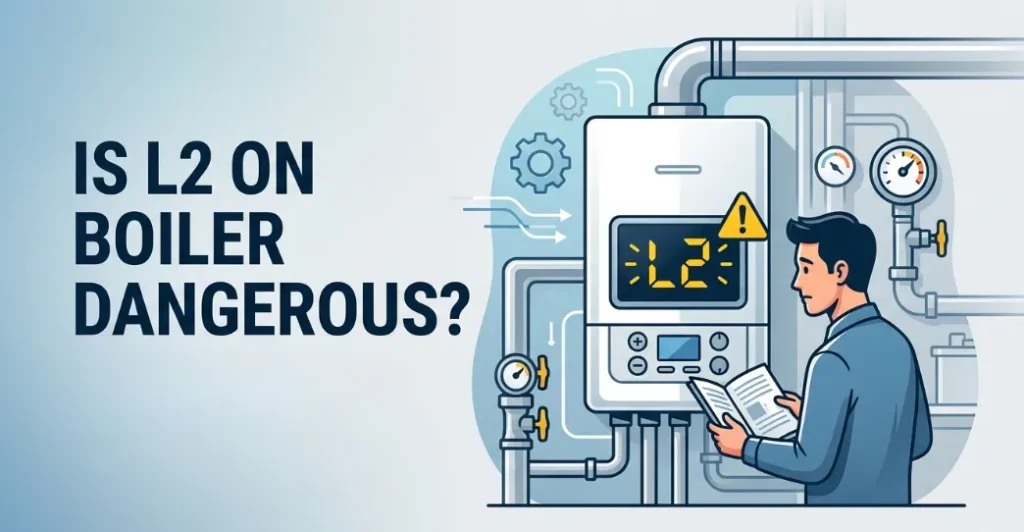
Homeowners often ask us: Is L2 on boiler dangerous? Technically, no. But when you see an L2 code on your boiler, it signals an underlying problem. L2 itself isn’t harmful, but if the L2 code is flashing, that’s a warning sign. Rather than panicking, take action and address it.
L2 codes can appear for many reasons. If DIY troubleshooting doesn’t resolve it, hire a professional heating engineer. Here’s a practical guide that explains what L2 means, common causes, the repair process, and essential safety tips.
What Does L2 Mean?
L2 is a safety feature that indicates the boiler’s ignition has stopped or is struggling to light. When your boiler flashes an ‘L2’ code, it means the ignition isn’t working and the safety lock has activated. If a blockage or another issue occurs with the boiler, the ignition will stop until the issue is resolved.
Common Causes of L2 Fault: Why Does it Happen?
A reason backs every happening thing. Consequently, L2 faults also happen for some reason. Some of the common causes are-
Frozen or Blocked Condensate Pipe
In winter, the cold weather can block the condensate pipe(white or black) leading outside. The pipe gets frozen and locked inside. That’s when the boiler can’t flame properly and flashes L2 code.
Lack of Gas Pressure
For optimal boiler performance, gas pressure must be within the specified range. Insufficient gas pressure can lead to a weak flame or trouble with ignition. If ignition is compromised, the boiler may display an L2 code.
Faulty Ignition Components
A spark generator, the electrode, or the ignition lead can be faulty. If that happens, the boiler can not create enough spark to ignite the gas, which causes the L2 faulty code.
Dirty Flame Sensor
A dirty flame sensor can send the boiler the wrong signal that there is no flame, causing it to shut down, supply no gas, and flash the L2 code on the display.
Ventilation Fault
Blocked flue vents, disrupted air flow, or nests can create obstacles that cause an L2 fault. Flue blockage may also obstruct ignition.
Low modulation in the Gas valve
The gas valve may be stuck or cause low modulation. This can impact the gas flow to the burner and prevent ignition due to a lack of gas.
PCB Faults
If the control board isn’t matching or communicating with ignition sensors, there can be an L2 fault. It’s a rare reason, though.
Is L2 on Boiler Dangerous: How Can You Fix It?
Obviously, you can’t fix everything. What if some minimal settings can fix the error? You never know. Start with the basics. Do whatever you can, and when you become unsure of the next step, call the professional heating engineers.
Here’s what you can do to fix the L2 issue:
Start with the Basics
First, you need to check the power. Check if the boiler is getting proper electric power and the fuse is okay. Then you need to check the gas connection. All the gas appliances must function well. Check if the isolation gas is open. If you’re using a prepaid meter, you must ensure you have credits.
Reset your Boiler
Almost every boiler comes with a reset button. Press the reset button and wait for a few seconds. It will reset. If the L2 issue goes away, then your job is done. However, if it still appears, you must address the underlying issues.
Check for Blockage or Ignition Faults
You must inspect if there is any blockage in the condensate pipe or any rubbish/dust in the flue pipe. Also, you should check if the ignition is a short-period intermittent flame. Then something must be wrong with the flame detection.
Pour Warm Water on a Frozen Condensate Pipe
If your condensate pipe is frozen, ot might be the reason behind the L2 code. Thaw the ice by pouring warm water on the outside of the pipe twice or thrice until the ice melts. Once it’s done, reset your boiler and check if the L2 issue has been cleared.
Check everything again
You might miss faults if you don’t check carefully. Start by inspecting the gas supply to confirm gas is reaching the appliances, and that the pipes and other fixtures are in good condition. Once the basics are done, DIY is no longer enough—you’ll need professional help.
When to call Professionals?
Once you’ve done whatever could be done with DIY, you must contact a professional boiler service provider. You can’t wait to increase the risk, as there can be dangerous issues like gas leaks, carbon monoxide leaks, etc. Call a professional when-
L2 fault? Prevent Anyway: Safety Tips for UK Homes
Once you face an L2 fault, you don’t want this to happen again, right? What can you do to prevent L2 faults? Here’s the safety guide you’re looking for:
Conduct an annual boiler service
Annual boiler service keeps the boiler clean, helps you check gas appliances and ignition sensors, and alerts you to any minor issues. It helps you inspect and work on that immediately and prevent L2 issues.
Ensure the Vents and Pipes are Clear
Keep air vents and pipes clear of rubbish and dust to prevent blockages. If a blockage occurs due to cold weather, check it immediately. Also, keep plants away from the air vents.
Monitor your Boiler Gas Pressure Regularly
Take care of the gas pressure as it fuels your boiler. If you use a prepaid meter, keep your meter in credit. Low gas pressure or lack of credit may cause L2 faults.
Insulate your Condensate Pipe
It’s best to insulate your condensate pipe before it freezes. If ice has already formed, you can insulate once it’s thawed. Either way, insulation helps prevent the pipe from freezing in cold weather.
Take Steps Immediately
Don’t wait too long if you see dark marks on the boiler, any unpleasant noise, or an ignition problem. Even a small hole can sink a giant boat, so be careful. Contact professionals without waiting for the cold weather to come.
Bottom Line
Is L2 on boiler dangerous? Now you know the answer. An L2 fault can hint at a major underlying issue. So you can’t skip that.Try to solve it yourself; if you fail, leave the rest to the experts.
Following proper safety guidelines and scheduling yearly boiler service can reduce the risk of L2 faults. Monitor your boiler continuously to head off unexpected outages.
(FAQs): Frequently Asked Questions
Is an L2 code serious for boilers?
L2 code is not a serious problem for boilers in itself. However, it indicates an underlying issue that might be a major threat.
Can I fix an L2 boiler fault myself?
You can only fix the basics. However, if your boiler still shows an L2 fault after basic settings, you must call a professional heating engineer.
What does L2 indicate on a boiler?
L2 on a boiler indicates that the boiler has a problem in the ignition flame, ignition system, gas pressure, or flame sensor. The underlying problem needs to be addressed. If a boiler can’t ignite, it displays the L2 fault.
Is it safe to use a boiler with a fault?
An L2 fault on your boiler means it isn’t safe to run. A faulty boiler can leak gas or carbon monoxide and pose serious hazards. Shut it off and keep it off until a qualified professional checks it.
What is the lifespan of a boiler?
Typically, a boiler’s lifespan is 10-15 years if maintained regularly. However, some boilers have a 20-year lifespan.
Should I turn my boiler off if it has a fault?
Yes, you should. A hidden danger can be underlying a faulty boiler. So you must turn it off and call experts to check the boiler.
Does home insurance cover boiler failure?
No, standard home insurance doesn’t cover boiler failures. You will require an individual policy to cover boiler failure.